A Buyers Guide to Spiral Vibratory Elevators and Vertical Material Handling
To choose a spiral vibratory elevator, consider your material type, required throughput, lift height, available floor space, construction material, process requirements such as cooling or drying, and the supplier’s support capabilities.
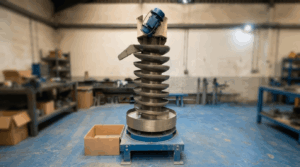
A spiral vibratory elevator, also called a vibratory spiral conveyor, is a machine that lifts bulk materials vertically along a helical trough using controlled vibration, without belts, buckets or screws. For facilities short on floor space, it can be a compact, low-maintenance alternative to belt conveyors and bucket elevators. Here are the seven factors to consider before you buy.
1. Know your material and product characteristics
Start with what you need to move: granules, powders, small packaged goods or mechanical parts. Note the particle size, how fragile the product is, and whether it is sticky, abrasive or prone to clumping.
A spiral vibratory elevator handles product gently, which makes it well suited to delicate items such as food products and pharmaceuticals. Sharing your material details with the manufacturer early helps confirm the right design.
2. Define your throughput (capacity per hour)
Work out how much material you need to lift per hour, and allow for peak loads as well as your average. Magnapower’s spiral vibratory elevators handle up to 10 cubic metres per hour, which suits small to medium bulk handling requirements. If you need much higher volumes, discuss your requirements with the supplier so they can advise on the best approach.
3. Check your height and footprint
Measure the vertical distance you need to cover and the floor space available. Magnapower’s spiral vibratory elevators are available in diameters up to 1.5 metres and heights up to 7 metres.
Inlet height matters too. A bottom drive can achieve a low inlet height, while a top drive suits other layouts.
4. Choose the right materials of construction
Mild steel is a practical choice for many industrial applications. For food, pharmaceutical or hygiene-critical processes, food-quality stainless steel with a food or pharmaceutical-grade finish is the better option.
5. Consider what else the elevator can do
Some processes need more than lifting. A spiral vibratory elevator can be configured to dry or cool product as it travels upwards, which can save a separate process step and further reduce your footprint.
6. Think about installation and maintenance
With few moving parts, a spiral vibratory elevator needs minimal maintenance and is easy to install. Even so, it pays to choose a supplier that supports you long after delivery.
Magnapower offers a full service and maintenance service, covering installation, parts, repairs and refurbishment, with experienced service engineers on hand before, during and after installation. Fast turnaround matters, because downtime is where the real costs sit.
7. Choose a supplier who can customise
Every process is different, so look for a supplier that offers customised designs and tests your material before recommending a solution. Magnapower’s spiral vibratory elevators are engineered by the specialist team formerly of Dynamic Handling Ltd, acquired in 2024, and backed by over 33 years of Magnapower’s experience in material separation and handling. Our UK and US facilities offer sample material testing, so recommendations are based on how your product actually behaves.
Quick reference: Spiral vibratory elevator specifications
| Factor | What to Consider | Magnapower Options |
| Diameter | Available space and capacity | Up to 1.5m |
| Lift Height | Vertical distance to cover | Up to 7m |
| Capacity | Volume per hour | Up to 10 cubic metres per hour (dependent on material and specification) |
| Drive | Inlet height | Top drive or bottom drive |
| Build | Hygiene needs | Mid steel or food-grade stainless steel |
| Extras | Whether product needs treating | Drying or cooling while elevating |
Need help selecting the right spiral vibratory elevator?
Frequently asked questions
Explore our FAQs for clear, helpful insights and the support you need, everything in one place.
How do I choose the right spiral vibratory elevator?
How does a spiral vibratory elevator work?
Vibratory motors create a combination of vertical and horizontal movement in a spiral trough. Material enters at the inlet and moves up the helix in a series of small hops, so it keeps a consistent flow without being dragged or crushed. Depending on the design, the same unit can also cool, dry, screen or accumulate product during elevation.
What materials can a spiral vibratory elevator handle?
They handle a wide range of bulk solids, from granules and powders to small packaged goods and mechanical parts. The gentle action suits delicate or fragile product that more aggressive conveying methods would damage. Very sticky, very wet or large lumpy materials need extra consideration, and we recommend sample testing in those cases.
Can spiral vibratory elevators be used in food or pharmaceutical applications?
Yes, spiral vibratory elevators are commonly used in food and pharmaceutical processing because they can be manufactured in food-grade stainless steel and offer gentle, hygienic material handling. Magnapower builds units in both mild steel and food-quality stainless steel depending on the application.
SERVICES
We have a comprehensive team of specialised service engineers that can assist you
We combine our experience and expertise with your requirements to provide you with equipment which is right for the job. We can test your material and show how and why Magnapower separators provide unrivalled efficiency and performance.